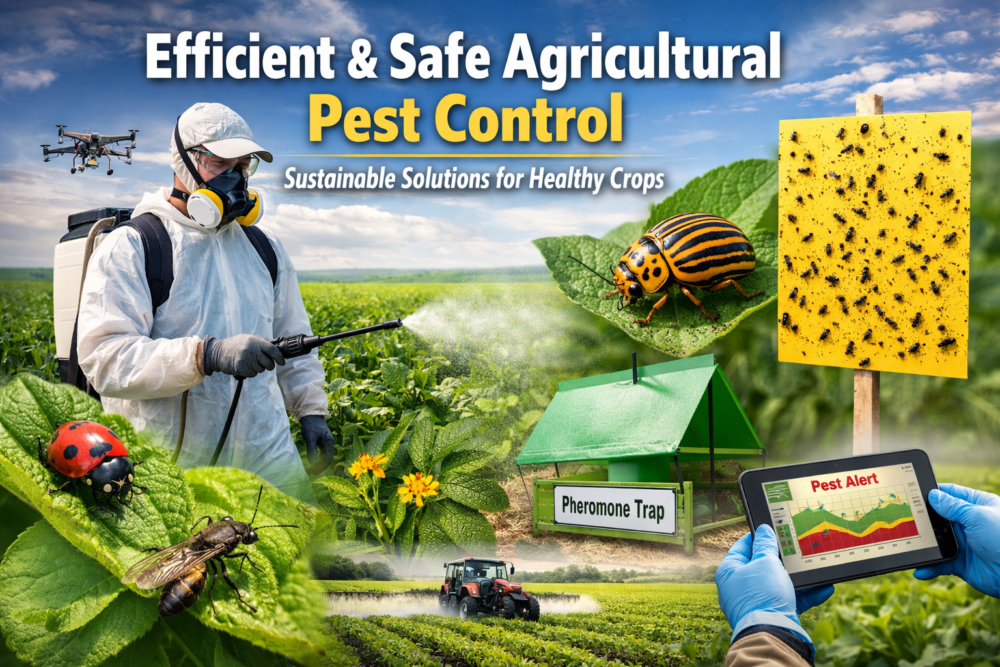
Introduction to Modern Pest Management
Agricultural pests threaten yields, quality, and farmer income worldwide.
Therefore, efficient and safe pest control ensures stable production and food security.
Moreover, modern strategies balance effectiveness with environmental responsibility.
Consequently, farmers now adopt integrated, science-backed solutions for lasting results.
Understanding Common Agricultural Pests
Insects, weeds, rodents, and pathogens damage crops at every growth stage.
Additionally, climate change expands pest ranges and increases outbreak frequency.
As a result, early identification becomes critical for timely intervention.
Furthermore, accurate diagnosis prevents unnecessary treatments and reduces costs.
Principles of Integrated Pest Management
Integrated Pest Management combines multiple control methods strategically.
First, prevention reduces pest establishment through healthy farming practices.
Next, monitoring guides decisions using thresholds and field observations.
Finally, targeted actions minimize risks to people and ecosystems.
Preventive Cultural Practices
Crop rotation disrupts pest life cycles effectively.
Similarly, resistant crop varieties reduce vulnerability naturally.
Proper spacing improves airflow and limits disease spread.
Meanwhile, balanced fertilization strengthens plant defenses consistently.
Biological Pest Control Solutions
Beneficial insects suppress pests without harmful residues.
For instance, lady beetles control aphid populations efficiently.
Likewise, parasitic wasps reduce caterpillar damage sustainably.
Thus, biological control supports long-term ecological balance.
Mechanical and Physical Control Methods
Physical barriers block pest access to crops.
Examples include nets, traps, and row covers.
Hand removal works well in small-scale operations.
Consequently, these methods lower reliance on chemicals.
Safe Use of Chemical Pesticides
Chemical pesticides remain valuable when used responsibly.
However, selection should favor low-toxicity formulations.
Proper timing increases effectiveness and reduces exposure.
Therefore, label compliance ensures safety and legal adherence.
Precision Application Techniques
Modern equipment delivers accurate pesticide placement.
As a result, drift and runoff decrease significantly.
Spot treatments address localized infestations promptly.
Hence, precision tools protect beneficial organisms effectively.
Organic Pest Control Options
Organic inputs offer safe alternatives for sensitive environments.
Neem oil disrupts insect feeding and reproduction.
Additionally, soaps and oils control soft-bodied pests.
Consequently, organic methods suit sustainable and export-oriented farms.
Monitoring and Early Detection
Regular scouting reveals pest trends early.
Furthermore, pheromone traps track population changes.
Digital tools now support data-driven decisions.
Therefore, timely action prevents severe infestations.
Resistance Management Strategies
Pests develop resistance through repeated exposure.
Thus, rotating modes of action preserves effectiveness.
Combining methods delays resistance development.
Ultimately, resistance management protects long-term productivity.
Environmental and Human Safety Considerations
Safety protects workers, consumers, and wildlife.
Personal protective equipment reduces applicator risk.
Buffer zones protect water sources and habitats.
Hence, safety measures build trust and compliance.
Regulatory Compliance and Training
Regulations guide safe pest control practices.
Training improves application accuracy and awareness.
Documentation supports traceability and audits.
Therefore, compliance enhances market access and credibility.
Economic Benefits of Efficient Control
Effective pest control increases yields and quality.
Moreover, reduced losses improve farm profitability.
Optimized inputs lower operational costs.
As a result, farmers achieve better returns sustainably.
Technology in Pest Management
Drones assist monitoring and targeted spraying.
Sensors provide real-time field insights.
Decision-support software optimizes interventions.
Consequently, technology elevates efficiency and safety.
Sustainable Outcomes for Future Farming
Sustainable pest control protects soil and biodiversity.
Additionally, it supports climate-resilient agriculture.
Community adoption amplifies regional benefits.
Ultimately, safe efficiency secures food systems globally.
Efficient and safe agricultural pest control drives sustainable success.
By integrating methods, farmers reduce risks and costs.
With continuous monitoring, outcomes remain predictable.
Therefore, responsible pest management ensures resilient farming futures.