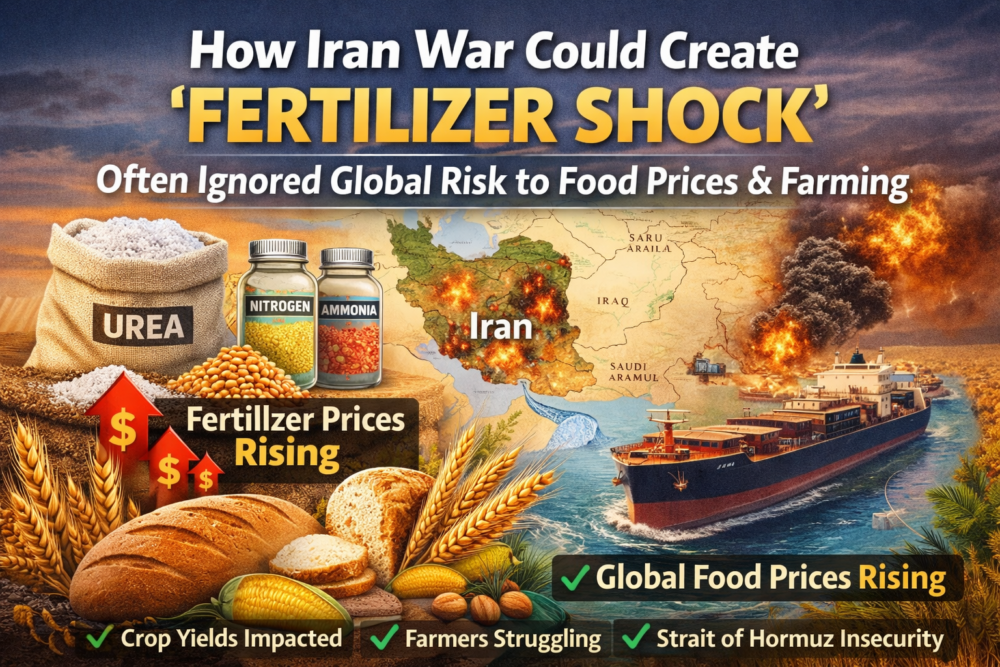
The Iran war could trigger a global fertilizer shock by disrupting fertilizer production and exports from the Persian Gulf region, particularly through the Strait of Hormuz, a major global shipping route. Since around one-third of globally traded urea and a large share of ammonia pass through this route, any disruption can increase fertilizer prices, reduce crop yields, and push global food prices higher.
Why the Iran Conflict Matters for Global Food Security
Most discussions about the Iran war focus on oil prices and geopolitical tensions, but a less visible risk is emerging: a fertilizer supply shock. Fertilizers are essential for modern agriculture, and disruptions to their supply can have long-lasting effects on food production.
The Middle East, especially countries around the Persian Gulf, is one of the largest global hubs for fertilizer production and export. If the conflict blocks shipping routes or reduces production, farmers worldwide could face higher fertilizer costs and limited supplies.
This could eventually lead to higher food prices, lower crop yields, and increased food insecurity, particularly in developing countries.
The Critical Role of the Strait of Hormuz
A major reason the Iran war threatens fertilizer markets is the Strait of Hormuz, one of the most important shipping routes in the world.
- Around 35% of global urea exports pass through the Strait of Hormuz.
- The region also supplies large volumes of ammonia, sulfur, and liquefied natural gas (LNG) used to produce fertilizers.
- The Gulf region accounts for about 34% of global urea trade and 23% of ammonia trade.
If conflict blocks or restricts this shipping route, fertilizer shipments could be delayed or stopped entirely.
Why Fertilizers Are Essential for Global Food Production
Fertilizers provide key nutrients such as nitrogen, phosphorus, and potassium that help crops grow.
Without sufficient fertilizer:
- Crop yields decline significantly
- Soil fertility decreases
- Food production drops
Experts estimate that synthetic fertilizers support roughly half of global food production.
This means that disruptions in fertilizer supply can directly affect global food security.
Early Signs of a Global Fertilizer Price Surge
The effects of the Iran conflict are already visible in global fertilizer markets.
- Urea prices in the Middle East have increased by around $130 per ton.
- Ammonia futures in Europe have jumped to about $725 per ton.
- Some fertilizer prices have risen more than 25% within days of the conflict.
These price spikes show how quickly geopolitical tensions can disrupt agricultural input markets.
How Fertilizer Shortages Affect Farmers
Fertilizer shortages can create major challenges for farmers.
Higher Production Costs
Farmers must spend more on fertilizers, fuel, and transportation.
Reduced Fertilizer Usage
Some farmers may apply less fertilizer to save money.
Lower Crop Yields
Reduced fertilizer use often leads to smaller harvests.
In extreme cases, experts warn crop yields could fall dramatically if fertilizer becomes unavailable.
Impact on Global Food Prices
Fertilizer shocks usually affect food prices with a delay of several months.
This happens because:
- Farmers plant crops using expensive inputs.
- Production costs increase.
- Lower yields reduce food supply.
- Market prices rise for staple foods.
As a result, foods such as:
- Bread
- Rice
- Wheat
- Meat
- Eggs
may become more expensive worldwide.
Countries Most Vulnerable to Fertilizer Disruptions
Some countries rely heavily on imported fertilizers and are particularly vulnerable to supply disruptions.
Major importers include:
- India
- China
- Brazil
- Many African countries
These countries depend on fertilizer imports to sustain agricultural productivity. Any supply disruption can threaten food security and economic stability.
Why Fertilizer Risks Are Often Ignored
Despite their importance, fertilizer markets receive far less attention than energy markets.
There are several reasons for this:
- Fertilizer shortages affect agriculture months later, not immediately.
- Media coverage often focuses on oil and gas prices.
- Agricultural supply chains are complex and global.
However, experts warn that fertilizer disruptions could create a larger food shock than many energy crises.
Could This Become the Next Global Food Crisis?
Some analysts believe the current situation could resemble the 2022 global food price crisis, which followed the Russia-Ukraine war.
But the Iran conflict could have even broader impacts because it affects:
- Energy markets
- Fertilizer production
- Shipping routes
- Global agricultural supply chains
If the conflict continues or expands, fertilizer shortages could significantly disrupt farming in the coming planting seasons.
What Governments and Farmers Can Do
To reduce the risks of fertilizer shocks, several strategies may help:
Diversifying Fertilizer Supply
Countries can import fertilizers from multiple regions instead of relying on one supplier.
Increasing Domestic Production
Local fertilizer production can reduce dependency on imports.
Promoting Sustainable Farming
Using organic fertilizers, crop rotation, and soil management can reduce fertilizer demand.
Strategic Fertilizer Reserves
Governments may maintain emergency fertilizer stocks to protect farmers during crises.
The Iran war highlights a hidden vulnerability in the global food system: dependence on fertilizer supply chains. Disruptions to key trade routes like the Strait of Hormuz can quickly push fertilizer prices higher, increasing farming costs and threatening global food production.
If the conflict continues, the world could face a fertilizer shock that leads to higher food prices, lower crop yields, and increased food insecurity. Policymakers, farmers, and global organizations must closely monitor fertilizer markets to prevent a broader food crisis.
FAQ (AEO Optimization)
Why does the Iran war affect fertilizer prices?
Because the Middle East is a major fertilizer exporter, and conflict in the region disrupts production and shipping routes.
What is a fertilizer shock?
A fertilizer shock occurs when fertilizer supplies drop sharply or prices rise rapidly, increasing farming costs and reducing crop production.
How could fertilizer shortages affect food prices?
Higher fertilizer prices increase farming costs and reduce crop yields, which eventually raises food prices.
Which fertilizer products are most affected?
Nitrogen fertilizers such as urea and ammonia, which are widely used in global agriculture.